

Repair or Replace Workwear: How to make the better choice for worn workwear?
Workwear is designed for demanding environments, but durable does not mean indestructible. After repeated use, washing and exposure to everyday working conditions, seams may open, zippers can fail, knees and elbows can wear thin, and fabrics may gradually lose strength. When these signs appear, the question is not simply whether the garment looks worn. The more useful question is: Can it still perform its job safely and effectively, or has it reached the point where replacement is the better option?
Making the right repair-or-replace decision can help businesses control workwear costs, maintain safety and professional standards, and avoid turning usable garments into textile waste too early. It is also an important part of circular textile management. Instead of following a take-make-use-discard model, circularity aims to preserve the value of garments and materials through durability, maintenance, repair, reuse and, eventually, recycling. The importance of designing garments to last and making them easier to repair is explored further in workwear design for longevity and circularity.
Repair or replace workwear: the quick answer
Repair workwear when the damage is limited, the surrounding material remains strong, the garment can still perform its intended function, and the repair can restore it to a safe and usable condition. Replace workwear when deterioration is widespread, safety or protective properties may be affected, repeated repairs are no longer practical, or the garment has reached the end of its functional life. The aim is not to make garments last forever. It is to avoid unnecessary replacement while getting the maximum safe and useful life from every garment.
When should worn workwear be repaired?
Many common signs of wear do not justify replacing an entire garment. Open seams, damaged pockets, missing buttons, loose hems, broken fasteners and some small tears can often be repaired when the surrounding fabric is still in good condition.
Before making the decision, assess five things:
- Extent of the damage: Is the problem limited to one area or spread throughout the garment?
- Strength of the surrounding fabric: Will the repaired area remain stable during continued use?
- Function of the garment: Does it have a protective, hygiene or visibility requirement that could be affected?
- Repair history: Is this an isolated repair or one of many recent failures?
- Expected remaining life: Is enough useful life left to make repairing the garment worthwhile?
A small repair can prevent a minor problem from becoming a larger one. For example, a seam that has only started to open may be relatively straightforward to restore. Continued use without repair could place additional strain on the area and result in more extensive damage.
This is one reason why early inspection and maintenance matter. Repairing garments while defects are still manageable can help keep workwear in circulation rather than replacing it prematurely. The environmental reasoning behind this approach is also discussed in why repairing a garment supports longer textile use.
When is replacement the better choice?
Repair should not become an objective in itself. Sometimes replacing worn workwear is the more sensible and responsible decision. A garment may be approaching the end of its usable life when the fabric has become thin across several high-wear areas, multiple components are failing, the fit has deteriorated or repairs are becoming increasingly frequent.
Replacement should also take priority when damage could interfere with the garment’s required function. This is particularly important for protective workwear. A garment used to support visibility, hygiene or protection against workplace hazards cannot be evaluated purely on appearance. Any repair must preserve the functionality required for the job. If a garment cannot be restored to the condition needed for its intended use, it should leave active service.
Don’t judge a garment by appearance alone:
One of the easiest mistakes in workwear management is equating “old” with “unusable” or “repaired” with “inferior.” A visible repair does not automatically mean a garment has lost its value. If the repair is appropriate, the fabric remains sound and the garment continues to meet its functional requirements, replacing it solely because it no longer looks new can create unnecessary textile consumption.
The opposite is also true. A garment can look acceptable while its most heavily used areas have become weakened. Cuffs, knees, elbows, pockets, inner thighs and other high-friction areas may deteriorate gradually. That makes systematic inspection more useful than decisions based only on appearance.
Why professional workwear maintenance changes the decision?
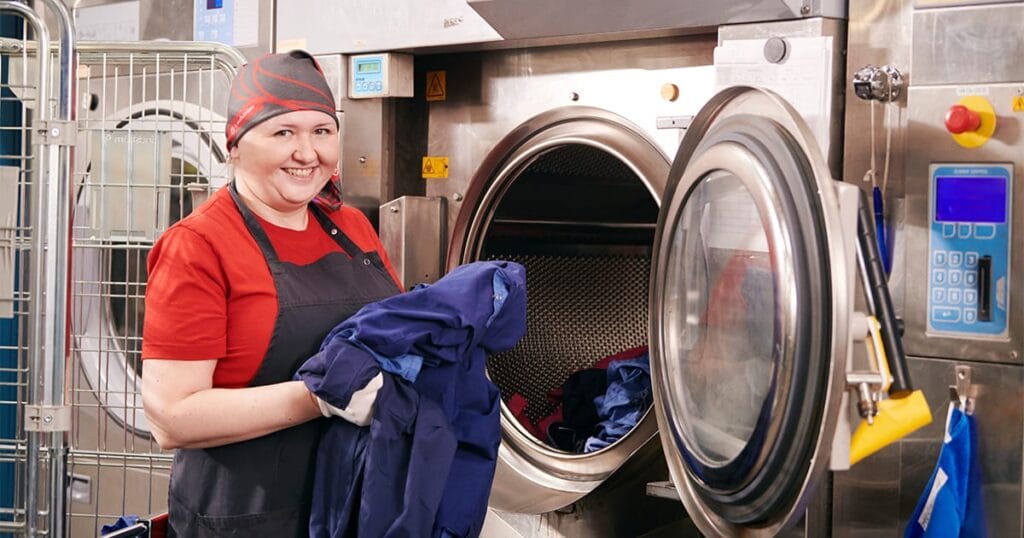
For organizations with hundreds or thousands of garments in circulation, managing inspections, laundering, repairs, replacements and inventory internally can become complicated. A managed workwear model can make these decisions part of a recurring process rather than something addressed only after a garment fails. Lindström describes workwear service and maintenance as an approach that brings activities such as laundering, repair and maintenance together throughout the garment lifecycle.
This is important because repair works best as part of preventive garment management. When garments are regularly returned, cared for and checked, minor problems can be identified sooner. Businesses are then in a better position to repair what remains useful and replace what has genuinely reached the end of its service life.

Repair is a core part of circular textiles:
Circular textiles are sometimes discussed mainly in terms of recycling. However, recycling takes place relatively late in a textile’s lifecycle. Before a garment becomes recycling material, there are several opportunities to preserve more of its existing value.
A useful hierarchy is:
Use well → Maintain → Repair → Reuse → Recycle
Repair sits near the beginning because a garment that remains functional after repair can continue serving its original purpose without requiring an immediate replacement. That means sustainability begins before the recycling bin.
Designing garments for durability and repairability also makes the system more effective. Lindström’s approach to designing for circularity and building workwear to last highlights how lifecycle thinking can start at the design stage instead of being considered only when a garment becomes waste.
How repair supports sustainable workwear management?
Every new garment requires materials and manufacturing. Keeping an existing garment productive for longer can therefore reduce the need to replace it prematurely. But sustainable workwear management goes beyond repairing holes. It includes selecting durable garments, matching workwear to actual working conditions, managing quantities carefully, maintaining garments correctly, repairing damage early and considering what happens when a garment can no longer perform its original role.
Avoiding unnecessary inventory is another piece of the same puzzle. Producing or purchasing workwear that never enters meaningful use still consumes resources. The principle behind producing workwear according to actual demand shows why managing textile quantities matters alongside extending garment life.
Sustainable workwear management is about much more than what happens at end of life. It begins with choosing garments suited to their working environment and continues through proper use, washing, maintenance, timely repair and efficient stock management.
A more sustainable workwear lifecycle can include:
- Choosing durable garments.
- Matching garments to the actual job.
- Providing employees with the correct sizes.
- Caring for textiles correctly.
- Identifying minor damage early.
- Repairing wherever safe and practical.
- Reusing suitable garments.
- Avoiding unnecessary replacement.
- Managing end-of-life materials responsibly.
The UN Environment Programme’s work on sustainable and circular textiles similarly treats textile circularity as an issue spanning the entire value chain rather than merely a question of what happens to waste.

Think in terms of lifecycle value, not simply repair cost:
A repair-or-replace decision should not be based only on whether fixing a zipper cost less than purchasing a new garment. The better question is how much safe and useful life the repair is likely to restore. Repairing a relatively new, structurally sound garment can deliver good lifecycle value. Continuing to repair a heavily deteriorated garment that is likely to fail again shortly may not.
Businesses should therefore consider garment condition, function, repair history, expected remaining life, replacement requirements and environmental impact together. This turns workwear management from a series of isolated purchasing decisions into lifecycle management.
From linear workwear consumption to a circular model:
The linear approach to workwear is familiar:
Buy → Use → Wear out → Replace → Discard
A circular model adds several opportunities to keep products and materials valuable:
Design for durability → Use → Maintain → Repair → Reuse → Recycle
The difference is significant. Replacement remains part of the model, but it becomes a considered decision rather than the automatic response to wear. That is the central idea behind a more circular economy for the textile industry: extend textile lifetimes, maintain their value and consider reuse or recycling once their original function is no longer possible.
Making the better repair-or-replace decision:
The best workwear strategy is neither “always repair” nor “replace when it looks old.” It is to keep each garment performing safely and effectively for as long as reasonably possible. Repair when damage is limited and full functionality can be restored. Replace when deterioration, safety concerns or repeated failures mean the garment no longer has enough useful life. Combine that decision with durable garment design, professional maintenance, reuse and responsible end-of-life management, and workwear becomes part of a much more circular system.
A repaired seam or replaced zipper may seem like a small intervention. Across an entire workwear fleet, however, better decisions about when to repair and when to replace can help businesses reduce avoidable waste, use textile resources more effectively and make sustainability part of everyday operations rather than an end-of-life exercise.

Frequently Asked Questions:
How should a business decide whether worn workwear still has enough useful life to justify repair?
Look beyond the damaged component. If the surrounding fabric remains strong, the garment still fits correctly and its required function can be restored, repair may offer meaningful additional use. If several areas are already deteriorating, replacement may provide better lifecycle value
Should companies set a maximum number of repairs for each workwear garment?
A fixed repair limit can be too simplistic because garments wear differently depending on their material, job and working conditions. A better approach is to consider repair history together with fabric condition, functionality and the expected life remaining after the next repair.
Does a visible repair make workwear unsuitable for customer-facing employees?
Not automatically. The decision depends on the quality and location of the repair as well as the company’s appearance standards. A neat repair on an otherwise professional garment may be acceptable, while extensive visible deterioration may justify replacement.
How can workwear repair records improve future garment selection?
Repeated damage in the same location can reveal useful patterns. If a particular garment frequently fails at the knees, pockets or seams, that information can help procurement and workwear teams choose stronger materials, different construction or a design better suited to the job.
Can seasonal workwear be reused rather than replaced before each season?
Yes, when garments have been stored correctly and remain suitable for the job. Inspect seasonal workwear before returning it to circulation so that damaged fasteners, weakened areas, fit changes or other problems can be addressed first.
How can businesses tell whether repeated workwear damage is a garment problem or a workplace problem?
Look for patterns across users, tasks and locations. Similar failures across many garments may indicate that the garment specification is not suitable for the work, while damage concentrated around a particular task or workstation may point to an operational cause that should also be investigated.

Related

What does a workwear designer do? Lindström designers Jenny Selroos and Karmen Lond explain the inner workings of workwear design.

The term circular textiles is becoming increasingly familiar, but what does it actually mean? In simple terms, a circular textile system aims to keep garments...
Know how modern workwear procurement improves compliance, garment traceability, hygiene and inventory efficiency in pharma and food processing.
