Cleanroom Safety Shoes: ISO Standards, GMP Compliance, and Contamination Control Best Practices
Cleanroom safety shoes are an important part of contamination control in pharmaceutical manufacturing, biotechnology, medical device production, laboratories, and other controlled environments. Footwear is not only a worker safety item. It is also part of a wider cleanroom control system that helps protect product quality, reduce particle transfer, support GMP expectations, and maintain cleanroom discipline.
In some controlled environments, facilities may also use cleanroom safety shoes where higher coverage, additional protection, or stricter gowning requirements are needed. Whether a facility uses cleanroom safety shoes, cleanroom boots, or a combination of both, footwear should support hygiene, cleanability, controlled movement, and worker safety.
In cleanroom operations, people are one of the most significant potential sources of contamination. Every item worn by employees, including footwear, should support cleanroom hygiene and controlled movement. For QA teams, procurement managers, EHS professionals, facility heads, and production leaders, the right cleanroom safety shoes can help reduce contamination risks, improve worker comfort, simplify footwear management, and support audit readiness.
What are cleanroom safety shoes?
Cleanroom safety shoes are protective shoes designed for controlled environments where contamination control is essential. Unlike standard safety footwear, cleanroom-compatible shoes should support hygiene, cleanability, low particle transfer, and safe movement inside cleanroom areas.
Depending on the cleanroom classification and gowning requirements, facilities may choose low-cut cleanroom safety shoes or higher-coverage cleanroom safety shoes. Cleanroom boots may be preferred in areas where additional leg or ankle coverage is required, or where the gowning procedure calls for more complete lower-body protection.
They are commonly used in industries such as:
- Pharmaceutical manufacturing.
- Biotechnology.
- Medical device manufacturing.
- Laboratories.
- Sterile production areas.
- Semiconductor and electronics cleanrooms.
- Healthcare and controlled processing environments.
Cleanroom safety shoes should be evaluated not only by price, but also by cleanability, durability, worker comfort, compliance support, lifecycle management, and replacement control.
Why cleanroom safety shoes are essential for contamination control?
Footwear is always in contact with floors, gowning rooms, corridors, airlocks, and production spaces. If shoes are not suitable for cleanroom use, they can collect dust, particles, residues, and microorganisms, then transfer them into controlled areas.
Cleanroom safety shoes help reduce this risk by supporting cleaner movement inside the facility. They should be easy to clean, suitable for dedicated cleanroom use, and compatible with the facility’s gowning and hygiene procedures.
In facilities with stricter gowning protocols, cleanroom safety shoes may also help reduce contamination transfer by providing greater coverage around the foot, ankle, and lower leg. The choice between cleanroom safety shoes and cleanroom boots should be based on the facility’s contamination control strategy, cleanroom classification, and process risk. This matters because cleanroom performance depends on controlling contamination from multiple sources, including people, garments, tools, materials, equipment, and footwear.
Cleanroom Footwear vs. Standard Safety Footwear:
Standard safety footwear is mainly designed to protect employees from workplace hazards such as impact, slipping, or sharp objects. Cleanroom safety shoes must do more. They need to protect workers while also supporting contamination control.
| Feature | Cleanroom Safety Shoes / Cleanroom Boots | Standard Safety Footwear |
|---|---|---|
| Main purpose | Worker safety and contamination control | Worker safety |
| Use area | Cleanrooms and controlled environments | General industrial areas |
| Cleanability | Designed to be easier to clean and maintain | May include rough, stitched, or absorbent areas |
| Particle retention | Lower particle retention when properly selected and maintained | May retain particles in seams, grooves, or absorbent materials |
| Contamination risk | Helps reduce particle transfer | May carry particles into cleanroom areas |
| Coverage | Shoes provide standard foot protection; cleanroom boots may provide higher coverage | Varies by general safety shoe type |
| Compliance role | Supports cleanroom SOPs, GMP expectations, and ISO-classified environments | Supports general PPE requirements |
| Maintenance need | Requires controlled cleaning, inspection, and replacement | Usually managed like regular safety shoes |
| Operational value | Supports quality, compliance, and process control | Supports basic workplace protection |
For pharmaceutical and cleanroom facilities, this difference is important. A shoe may be safe for a warehouse but unsuitable for a cleanroom if it is difficult to clean, retains particles, or is likely to carry contamination.
The role of footwear in cleanroom compliance:
Cleanroom compliance is not only about air filtration or room classification. It also depends on personnel hygiene, gowning discipline, cleaning routines, movement control, and approved PPE.
Footwear should be included in cleanroom SOPs. These SOPs should define:
- Which shoes or cleanroom boots are approved for each area?
- Where footwear is stored?
- How shoes are cleaned and inspected?
- How often footwear is replaced?
- How damaged or contaminated shoes are removed from use?
- How visitor and contractor footwear is managed?
- How footwear is controlled between different cleanroom zones?
FDA explains that CGMP regulations for drugs set minimum requirements for the methods, facilities, and controls used in drug manufacturing, processing, and packing. Footwear control supports this broader expectation by helping reduce contamination risks linked to personnel, movement, and protective apparel.
Why cleanroom safety shoes is a critical part of GMP compliance?
GMP compliance depends on hygiene, repeatability, documentation, and contamination prevention. Cleanroom safety shoes support these goals by helping control what employees bring into the manufacturing environment.
Under 21 CFR Part 211 personnel requirements, personnel involved in drug manufacturing must wear clean clothing suitable for their duties, and protective apparel must be used where needed to protect drug products from contamination.
GMP expectations do not usually prescribe one specific type of cleanroom shoe or cleanroom boot. Instead, they support the use of suitable protective apparel and contamination controls. Cleanroom safety shoes can form part of this control strategy when footwear poses a contamination or safety risk.
For pharmaceutical facilities, this means cleanroom safety shoes should not be treated as an informal item. It should be part of a controlled PPE and cleanroom garment strategy, especially in areas where product quality, audit readiness, and contamination control are critical.
How specialized footwear supports ISO cleanroom standards?
ISO cleanroom standards focus on controlling airborne particle concentrations in cleanrooms and clean zones. ISO 14644-1 classifies cleanrooms based on air cleanliness by particle concentration.
Cleanroom safety shoes do not make a facility ISO-compliant on their own. Instead, they support the facility’s ability to maintain its ISO-classified environment by reducing particle transfer and supporting controlled gowning practices.
Specialized cleanroom footwear, including cleanroom boots where required, supports ISO cleanroom performance by reducing the chance of particle transfer from footwear into controlled areas. Dedicated cleanroom shoes and boots also help maintain zoning discipline. Footwear used inside cleanroom areas should not be worn in outdoor areas, warehouses, offices, or general production spaces.
Cleanroom safety shoes standards and certifications:
There is no single cleanroom safety shoe that fits every facility. The right choice depends on cleanroom classification, product risk, floor conditions, cleaning method, employee safety requirements, and regulatory expectations.
Facilities should check:
- Cleanroom compatibility.
- Cleanability and disinfection suitability.
- Slip resistance.
- Material durability.
- Low particle-shedding design.
- Smooth, non-shedding upper materials.
- Easy-to-clean sole design.
- Low particle retention.
- Compatibility with disinfectants.
- Comfort for long shifts.
- Availability of sizes.
- Whether cleanroom boots are required for higher-coverage gowning.
- Supplier documentation.
- Replacement and maintenance support.
- Compatibility with the facility’s SOPs.
In regulated industries, the footwear program should be easy to explain during audits. It should show that the facility has considered contamination risk, worker safety, and lifecycle control.
Final footwear selection should always be based on the facility’s contamination control strategy, cleanroom classification, risk assessment, and local regulatory requirements.
How cleanroom safety shoes reduce particle contamination and improve workplace safety?
Cleanroom safety shoes help reduce particle contamination by limiting the transfer of dust and residues from uncontrolled areas into cleanroom spaces. They also support workplace safety by improving grip, protection, and comfort during long shifts.
This is especially important in pharmaceutical and biotech facilities where employees may stand for long periods, move across smooth cleanroom floors, and work around sensitive products or equipment.
In areas with more demanding gowning requirements, cleanroom boots may provide additional coverage and help support more controlled movement between zones.
The best footwear program protects both the product and the employee. This can support fewer contamination investigations, better employee compliance, fewer footwear-related complaints, and stronger audit confidence.
How to choose the right cleanroom safety shoes for your facility?
Choosing cleanroom safety shoes should start with a risk-based approach. Procurement should not make the decision alone. QA, EHS, production, facility management, and cleanroom users should all be involved.
Key selection criteria include:
- Cleanroom classification and process risk.
- GMP and internal SOP requirements.
- Whether shoes or cleanroom boots are more suitable for the area.
- Worker safety hazards.
- Cleaning and disinfection method.
- Comfort during long shifts.
- Slip resistance.
- Material quality.
- Replacement frequency.
- Supplier service capability.
- Total cost of ownership.
For cleanroom facilities, the question is not only “Which shoe should we buy?” A better question is: “How will we keep cleanroom safety shoes available, clean, compliant, inspected, and replaced throughout their lifecycle?”
Cleanroom safety shoes selection checklist:
| Requirements | What to Check |
|---|---|
| Cleanroom compatibility | Suitable for the cleanroom classification, process risk, and internal SOPs. |
| Footwear type | Decide whether cleanroom safety shoes, cleanroom boots, or both are required. |
| Cleanability | Smooth surfaces, minimal dirt traps, and easy-to-clean sole design. |
| Contamination control | Low particle retention and low-shedding materials. |
| Safety | Slip resistance, stable sole, and toe protection if required by risk assessment. |
| Comfort | Suitable fit, cushioning, and support for long shifts. |
| Material suitability | Durable, non-absorbent where needed, and compatible with disinfectants. |
| Zone control | Dedicated footwear for specific cleanroom areas or cleanliness zones. |
| Storage | Controlled storage away from outdoor footwear and uncontrolled areas. |
| Maintenance | Defined cleaning, inspection, and replacement process. |
| Documentation | Inspection records, replacement records, cleaning records, and SOP alignment. |
| Supplier support | Availability, size management, lifecycle support, and service capability. |
| Sustainability | Reuse, repair, responsible replacement, and disposal approach. |
How to clean and maintain cleanroom safety shoes?
Cleanroom safety shoes should be cleaned and maintained according to a written procedure. Informal cleaning practices can create inconsistency and increase contamination risk.
A cleanroom footwear maintenance program should include:
- Regular inspection.
- Defined cleaning method.
- Approved cleaning agents.
- Controlled drying and storage.
- Damage reporting.
- Replacement criteria.
- Documentation.
- Employee training.
Cleaning should focus on soles, sidewalls, and any area where particles can collect. For cleanroom boots, maintenance should also include the shaft, closures, seams, and any higher-coverage areas that may collect particles. Shoes and boots should be stored in a designated clean area and kept separate from outdoor footwear. Damaged or difficult-to-clean footwear should be removed from use.
Common mistakes when selecting cleanroom safety shoes:
One common mistake is choosing footwear based only on unit price. Low-cost shoes may wear out faster, be harder to clean, or fail to support cleanroom requirements.
Another mistake is using standard industrial footwear inside cleanrooms. These shoes may protect workers but may not be suitable for contamination-controlled environments.
Other common mistakes include:
- Ignoring cleanroom classification.
- Not involving QA and EHS in selection.
- Overlooking comfort.
- Not defining cleaning responsibility.
- Choosing cleanroom safety shoes when cleanroom boots are required by the gowning procedure.
- Failing to set replacement criteria.
- Not managing visitor footwear.
- Not documenting footwear procedures.
- Assuming ISO-classified rooms automatically make all PPE suitable.
These mistakes can increase hidden costs and compliance risks.
The hidden risks of improper cleanroom safety shoes:
Improper cleanroom safety shoes can create risks that are not immediately visible. Shoes can carry particles into cleanrooms, collect residues in hard-to-clean areas, reduce grip on smooth floors, and cause worker discomfort.
In pharmaceutical and medical device environments, poor footwear control can contribute to:
- Contamination investigations.
- Failed internal inspections.
- Audit observations.
- Product quality concerns
- Production delays.
- Higher cleaning w.orkload.
- Employee safety incidents.
How ergonomic cleanroom shoes reduce worker fatigue?
Cleanroom employees often stand or walk for long periods. Poor cleanroom safety shoes can lead to discomfort, fatigue, reduced concentration, and lower compliance.
Ergonomic cleanroom safety shoes should provide:
- Good fit.
- Cushioning.
- Stability.
- Slip resistance.
- Lightweight comfort.
- Support during long shifts.
Where cleanroom safety shoes are used, they should also provide comfort and mobility without restricting movement unnecessarily. Employee comfort has a direct operational impact. Comfortable cleanroom shoe can improve compliance, reduce complaints, support productivity, and help workers follow cleanroom procedures consistently.
How often should cleanroom safety shoes be replaced?
There is no universal replacement timeline for all cleanroom safety shoes. Replacement depends on usage frequency, cleaning intensity, floor conditions, material durability, and cleanroom classification.
A facility should define replacement rules in its SOPs. Shoes used daily in high-control pharmaceutical areas may need replacement sooner than shoes used occasionally in lower-risk zones. Cleanroom boots should also be inspected regularly, especially around soles, shafts, closures, and seams.
Replacement should be based on both time and condition. Regular inspection helps ensure shoes and boots are replaced before they become a contamination or safety risk.
Signs it’s time to replace your cleanroom safety shoes:
Cleanroom safety shoes should be replaced when they show signs of wear or when they no longer support cleanroom requirements.
Common replacement signs include:
- Worn soles.
- Loss of grip.
- Cracks or tears.
- Damaged uppers.
- Peeling material.
- Persistent contamination.
- Poor fit.
- Reduced comfort.
- Difficulty cleaning the shoe.
- Damage to cleanroom boots, including worn shafts, damaged closures, or cracked surfaces.
- Failure to meet internal SOP requirements.
A managed rental model can help reduce the risk of delayed replacement by making shoe lifecycle management more structured.
Comparing Reusable and Disposable cleanroom safety shoes Options:
Reusable and disposable cleanroom shoe both have a role, but they serve different needs.
Reusable cleanroom safety shoes and cleanroom boots are usually better for regular employees because they offer better comfort, durability, and long-term value. They also fit well into a rental and maintenance model.
Disposable footwear, such as shoe covers or disposable overboots, may be useful for visitors, contractors, maintenance tasks, or temporary access. However, disposable options may create more waste and may not provide the same comfort, durability, or protection as reusable footwear.
Lindström’s cleanroom service model is built around reusable products. The company states that reusable cleanroom products, including garments, goggles, mops, and socks, can be washed multiple times before replacement, helping reduce environmental impact.
Why rent cleanroom safety shoes instead of buying them?
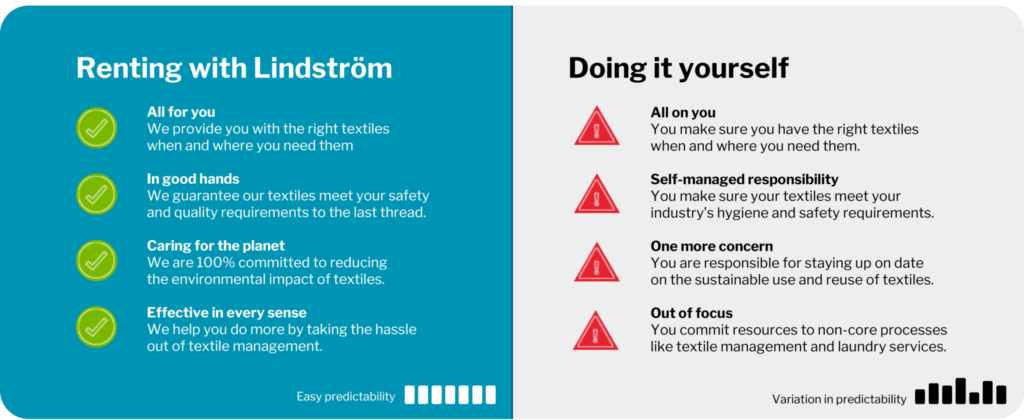
Renting cleanroom safety shoes can be more efficient than buying them, especially for pharmaceutical and controlled-environment facilities where hygiene, compliance, stock availability, and replacement control are important.
When a company buys footwear, it must manage:
- Size availability
- Stock planning
- Cleaning schedules
- Storage
- Inspection
- Replacement
- Damaged footwear
- Disposal
- Internal documentation
A rental model reduces this workload by shifting much of the lifecycle management to a professional service partner. This can apply to cleanroom safety shoes and, where included in the local service scope, cleanroom boots as well.
How Lindström is better than managing cleanroom footwear In-House?
The real cost of cleanroom safety shoe is not only the purchase price. Internal management also includes procurement time, storage, cleaning, inspection, replacement, compliance tracking, and disposal.
The table below applies Lindström’s cleanroom and workwear service principles to cleanroom footwear management, including cleanroom safety shoes and cleanroom boots where suitable.
| Comparison Area | In-House Cleanroom Shoe Management | Lindström Rental Service Approach |
|---|---|---|
| Upfront investment | Requires buying footwear and extra stock | Rental model can reduce capital investment and support predictable service costs |
| Stock availability | Risk of shortages, overstocking, or wrong sizes | Needs assessment and planned delivery help maintain availability |
| Cleaning responsibility | Managed internally, adding workload | Service model includes professional laundry and maintenance for cleanroom textiles and workwear |
| Replacement control | Internal team must track damage and wear | Lindström’s workwear model includes repair and replacement of damaged items |
| Compliance support | Depends fully on internal SOP discipline | Lindström cleanroom services operate according to ISO 14644 and GMP procedures |
| Delivery and collection | Internal team must distribute and collect items | Lindström delivers clean items and collects used items on an agreed schedule |
| Traceability | Manual tracking can be time-consuming | Lindström uses UHF chips and the eLindström portal for cleanroom garment lifecycle tracking |
| Internal workload | Higher workload for QA, facility, and procurement teams | Managed service reduces day-to-day textile handling tasks |
| Sustainability | Disposal and replacement must be handled internally | Lindström supports reuse, repair, recycling, and responsible disposal |
| Operational value | More internal control, but higher workload | Outsourced lifecycle management with service consistency |
Lindström also uses smart workwear technology to support visibility into usage, storage quantity, delivery dates, delivery quantities, inventory management, and real-time online reporting through RFID-based solutions.
Conclusion:
Cleanroom safety shoes are more than protective footwear. For cleanroom facilities, they support contamination control, GMP compliance, ISO cleanroom performance, employee safety, and operational efficiency. In some areas, cleanroom boots may also be needed to provide additional coverage and support stricter gowning requirements.
The right footwear program should cover selection, cleaning, storage, inspection, replacement, documentation, and employee training. For pharmaceutical and controlled-environment companies, a managed rental approach can reduce internal workload and improve consistency.
Lindström’s cleanroom and workwear service model demonstrates how professional textile rental can support hygiene, safety, compliance, traceability, and sustainability. For facilities that want a more reliable way to manage cleanroom safety shoes and cleanroom boots, rental-based footwear management can be a practical and scalable solution.

Frequently Asked Questions:
Are cleanroom safety shoes necessary for pharmaceutical manufacturing?
Yes. Cleanroom safety shoes help reduce contamination transfer, support worker safety, and strengthen GMP-related hygiene controls in pharmaceutical manufacturing environments.
Can standard safety shoes be used in a cleanroom?
Standard safety shoes are not always suitable for cleanrooms. They may have rough materials, stitching, deep sole patterns, or absorbent areas that can collect particles and make cleaning difficult.
Should cleanroom safety shoes be dedicated to one cleanroom area?
Yes. Dedicated footwear helps reduce cross-contamination between cleanroom zones and uncontrolled areas. Shoes used inside controlled areas should not be worn outdoors or in general facility areas.
Who should be involved in selecting cleanroom safety shoes?
Laundry affects garment cleanliness, particle control and garment life. If garments are washed or handled incorrectly, they may not support contamination control as intended.
Who should be involved in selecting cleanroom safety shoes?
QA, EHS, procurement, production, facility management, and cleanroom users should all be involved. This ensures the footwear meets compliance, safety, comfort, and operational requirements.
Can cleanroom safety shoes improve employee productivity?
Yes. Comfortable and ergonomic footwear can reduce fatigue during long shifts. When workers are comfortable, they are more likely to follow cleanroom procedures correctly and consistently.
What materials are best for cleanroom safety shoes?
Cleanroom safety shoes should use smooth, durable, low-shedding, and easy-to-clean materials. The material should also be compatible with the facility’s cleaning and disinfection procedures.
Is renting cleanroom safety shoes more cost-effective than buying?
For many facilities, renting can be more cost-effective because it reduces internal workload related to procurement, cleaning, maintenance, stock control, replacement, and disposal.
Do ISO standards certify cleanroom safety shoes directly?
Not usually. ISO 14644 classifies cleanrooms based on airborne particle concentration. Cleanroom safety shoes support the facility’s ability to maintain an ISO-classified environment, but they do not make a facility ISO-compliant by themselves.

Related

Learn how to choose flame resistant clothing based on workplace risks, protection, fit, comfort, fabric, maintenance and job requirements.

Plan a garments compliance audit around workplace risks. Explore garment checks, repairs, retirement, employee competency and workwear rental provider reviews.

Learn how cleanroom wipes affect particle transfer, with guidance on wiping pressure, batch traceability, internal audits and contamination control.